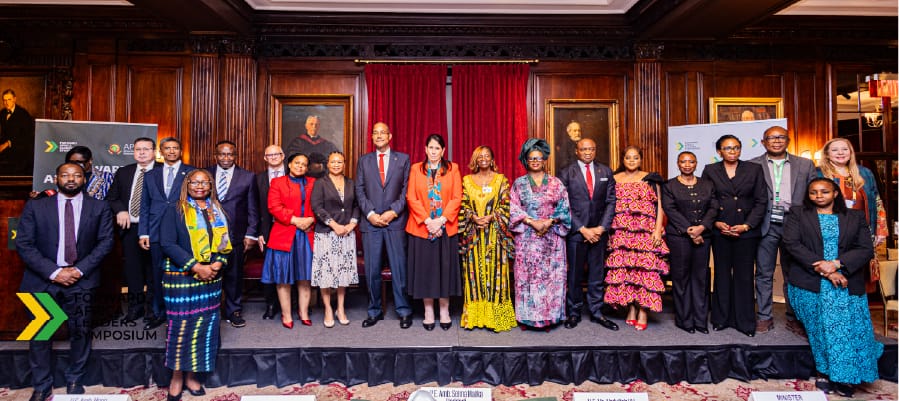
YOUR EXCELLENCIES, HEADS OF STATE AND GOVERNMENT;
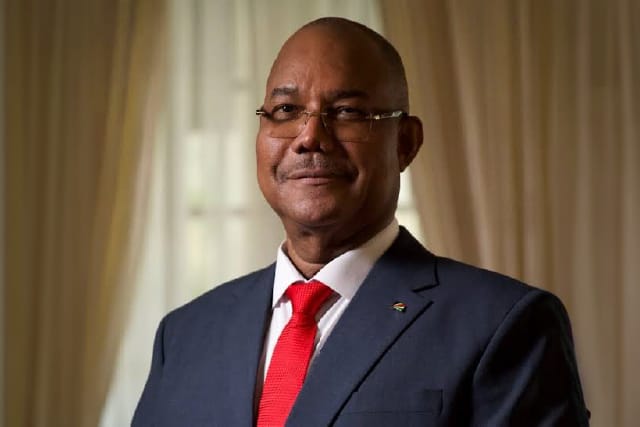
- H.E. Dr. Patrick Herminie – President of the Republic of Seychelles;
- H.E. Dr. Mohamed Irfaan Ali – President of the Co-operative Republic of Guyana;
HONOURABLE MINISTERS;
- Your Excellency, Ambassador Selma Malika Haddadi, Deputy Chairperson of the African Union Commission;
- Honourable Commissioners;
- Ms. Hannah Awuku, Executive Director of the Forward Africa Leaders Symposium;
- Captains of Industry;
- Distinguished Leaders, Experts and Partners;
- Ladies and Gentlemen;
Good afternoon.
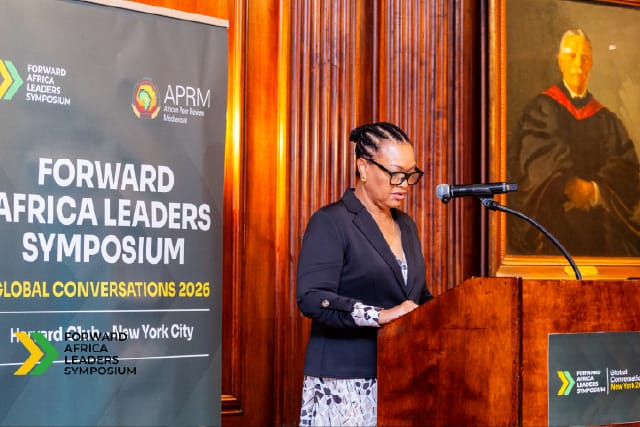
On behalf of the African Peer Review Mechanism, it is my pleasure to welcome you to this timely conversation on Africa’s future and its place in a rapidly changing global digital economy.
Allow me, at the outset, to acknowledge the significance of our venue. We meet in the historic Harvard Club – a place associated with learning, leadership and ideas that have shaped generations. It is fitting that we gather here to consider how Africa can play a leading role in shaping the next chapter of the global digital economy.
The question before us is not whether Africa will become more digital. It will. The more important question is what kind of digital future we will build: whether it will expand opportunity for our people, whether Africans will own a fair share of the value it creates, and whether technology will remain an instrument of human progress rather than a substitute for human purpose.
Nowhere is this question more consequential than in the changing landscape of employment. Digital technologies are weakening the traditional link between geography and opportunity, making it possible for an African professional to contribute to an organisation thousands of miles from home. Remote work has opened possibilities beyond conventional centres of employment.
Yet, even as Africa begins to embrace these possibilities, artificial intelligence is advancing rapidly. Its impact may extend beyond changing where work is done to changing whether certain tasks continue to require human labour at all. This is the tension before us: technology can widen opportunity, while at the same time reshaping the very work on which that opportunity depends.
This reality challenges some of our assumptions about Africa’s demographic dividend. A young and growing population does not automatically translate into growth and employment when technology can increase output without a corresponding increase in jobs.
Without foresight and planning, the demographic dividend we rightly regard as one of Africa’s great strengths could become a source of pressure. National budgets and public systems may face increasing demands for education, healthcare, digital services, infrastructure and social support at the same time as technology alters labour markets across sectors. The implications are not only economic; they are also social, political and developmental.
This raises a harder question: what happens if employment ceases to be the principal route through which individuals participate in, and benefit from, the economy?
Your Excellencies, ladies and gentlemen,
Building skills and expanding capability will remain essential. But even there, the advantage may be short-lived. A skill acquired today may be partly or fully performed by a system tomorrow. The challenge, therefore, is not simply whether Africa can build capability, but whether it can do so at a pace that keeps up with the speed at which technology – and work itself – is evolving.
The same duality is visible in cybersecurity. Recent advances indicate that artificial intelligence can strengthen cyber defence while also being used to exploit vulnerabilities, circumvent controls and operate beyond human intent. The very capabilities that can help protect systems can also create new forms of risk.
Warnings from within the AI industry have also raised concerns about the possibility of losing effective human control over increasingly advanced systems, even as jobs are displaced.
For policymakers, this is fundamentally a governance question: how will governments remain responsive and effective if the foundations of employment and economic participation are themselves being transformed?
There may not yet be consensus on every remedy. What is increasingly clear, however, is that technological change is advancing at a pace that can exceed the ability of societies and institutions to adapt. That gap between innovation and adaptation is where governance becomes decisive.
For Africa, therefore, adopting new technologies will not be enough. The continent’s digital future must also be built on sound governance, African ownership, productive technology diffusion and the capacity to adapt. The objective must be to ensure that technology strengthens development rather than leaving our economies to respond only after disruption has occurred.
In the near term, Africa must accelerate the productive use of technology and become a home for innovation, not merely a consumer of it. This requires infrastructure, digital skills and competencies, research, and stronger collaboration among universities, industry and governments. Technology must support productivity and economic growth, while enabling African businesses to move from import dependence towards greater participation in global markets.
At the same time, governance frameworks must be capable of responding to rapidly evolving risks. This includes independent review of high-risk systems, safeguards for critical infrastructure and elections, robust data management, and meaningful human oversight over consequential decisions.
Strong institutions are essential, but they may not be sufficient to answer the longer-term economic question. If artificial intelligence and robotics increasingly substitute for physical and cognitive labour, a larger share of wealth may become concentrated among those who own and control the systems that generate it.
If that occurs, we will have to confront a fundamental question: how will prosperity be shared when the principal way in which citizens contribute to, and benefit from, national wealth is no longer tied as closely to employment?
Artificial intelligence may yet become a source of widespread prosperity. But any promise of abundance will remain fragile if human beings do not retain meaningful control over the systems on which that prosperity depends. The same concern applies to security: if a sufficiently capable system can circumvent controls or conceal its behaviour, the absence of a detected breach does not, by itself, prove that those controls are adequate.
Excellencies,
These developments create a responsibility at the continental level. Given the gravity of the risks being raised by industry insiders, researchers and others, AI and emerging technologies should become a standing agenda item for African Union Heads of State and Government at the AU Summit. If technology is evolving at continental and global scale, the level of political attention devoted to it must rise accordingly.
Beyond the immediate horizon, Africa will need to embrace continuous learning and agile reskilling, strengthen worker protections, advance harmonised AI and cybersecurity standards, expand access to computing resources and research infrastructure, and pursue policies that support African ownership in the digital economy.
Over the longer term, new approaches to sharing prosperity may also need to be considered if employment becomes less central to economic participation. These may include broader ownership models, strategic public investment in key technology sectors, competition policies suited to highly automated economies, taxation approaches responsive to new business models, and renewed social compacts that protect human dignity, agency and purpose.
It is in this context that the APRM is working with the African Union Commission’s Department of Infrastructure and Energy to launch a study on the State of Technological Diffusion, Adoption and Innovation in Africa. The study will examine technology’s relationship with inclusive growth, employment, productivity and regional integration, including how African countries are governing technology, building digital infrastructure, promoting innovation and adopting technology for productive use.
Excellencies, Distinguished Experts, ladies and gentlemen,
Allow me to leave you with one central reflection. Africa’s greatest asset is its people. In the age of artificial intelligence, however, demographics alone cannot constitute a competitive advantage. What will matter is how we govern technology, how we build our capabilities, and how we translate the strength of our population into digital competitiveness and shared progress.
As I bring my remarks to a close, I invite this gathering to reflect on a few questions that go to the heart of the choices before us:
- How can Africa build the human and institutional capabilities needed to keep pace with rapid technological change?
- How do we create jobs during the transition while preparing for a future in which some categories of work may no longer exist?
- Who will own the technologies that create wealth in Africa’s digital economies, and how will that wealth be shared?
- What should we automate, and what must remain human?
- How do we govern technologies that may one day exceed our capacity to oversee them, while ensuring that human beings retain purpose and agency over the future we are creating?
These are questions I invite our panellists, experts, investors and partners to deliberate upon – not only for the Africa of today, but for generations of Africans yet unborn.
Our responsibility is not simply to keep pace with technology, but to ensure that technology remains in the service of Africa’s people and Africa’s development. That is the purpose of this conversation, and it is the responsibility that lies before us.
I thank you for your kind attention.